Multiple Access Protocol
Point-to-Point vs Broadcast Links
Networks can have two types of links:
- Point-to-Point Links: Direct connection between transmitter and receiver where the link is not shared (e.g., fiber optic, twisted pair)
- Broadcast Channels: Multiple transmitters and receivers connected via a shared channel (e.g., Ethernet, WiFi)
Important
Collision: Occurs when a node receives two or more signals simultaneously, causing interference and data corruption.
Motivation
A multiple access protocol is a distributed algorithm that determines how nodes share a communication channel - specifically deciding when a node should transmit.
Ideal Protocol Requirements
- Efficiency: When one node wants to transmit, it should send at full link rate bits/second
- Fairness: When nodes want to transmit, each should get bits/second on average
- Decentralization: No special coordinator node (preferred when possible)
- No Synchronization: No requirement for synchronized clocks or time slots (when possible)
- Simplicity: Easy to implement in networks
Taxonomy of MAC Protocols
MAC protocols can be categorized into three main types:
- channel partitioning: divide channel into pieces for exclusive use (fair, not efficient)
- random access: nodes transmit randomly, collisions possible (efficient, not fair)
- taking turns: nodes take turns transmitting (balances efficiency and fairness)
Channel Partitioning
Time Division Multiple Access (TDMA)
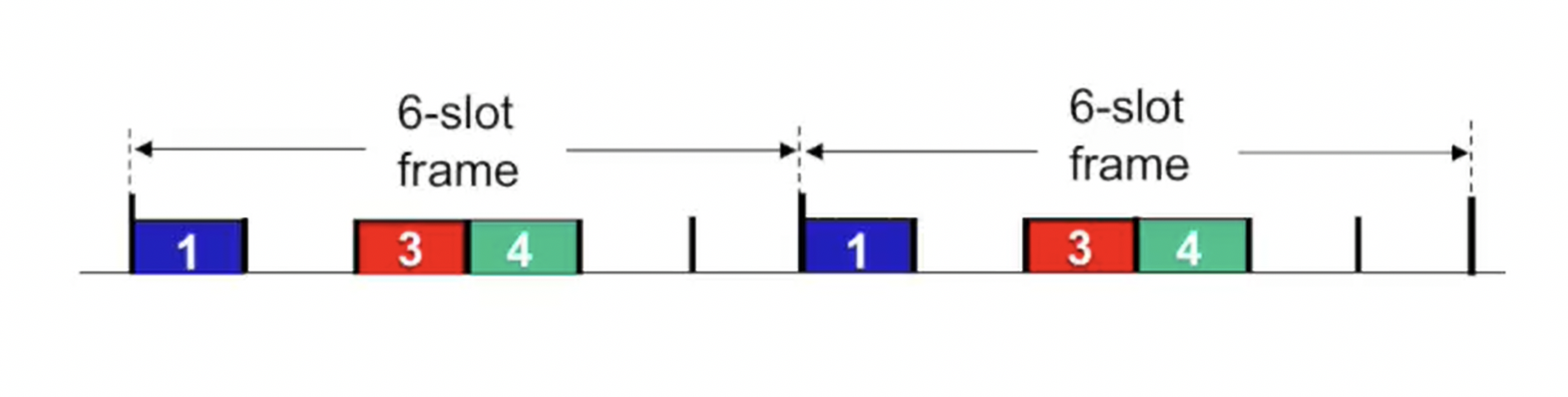
- Idea: divide time into equal-size slots, assign each station a fixed slot in rotating frames
- Pros: achieves fairness, simple implementation
- Cons: Bandwidth waste when nodes have nothing to transmit (static allocation)
Frequency Division Multiple Access (FDMA)
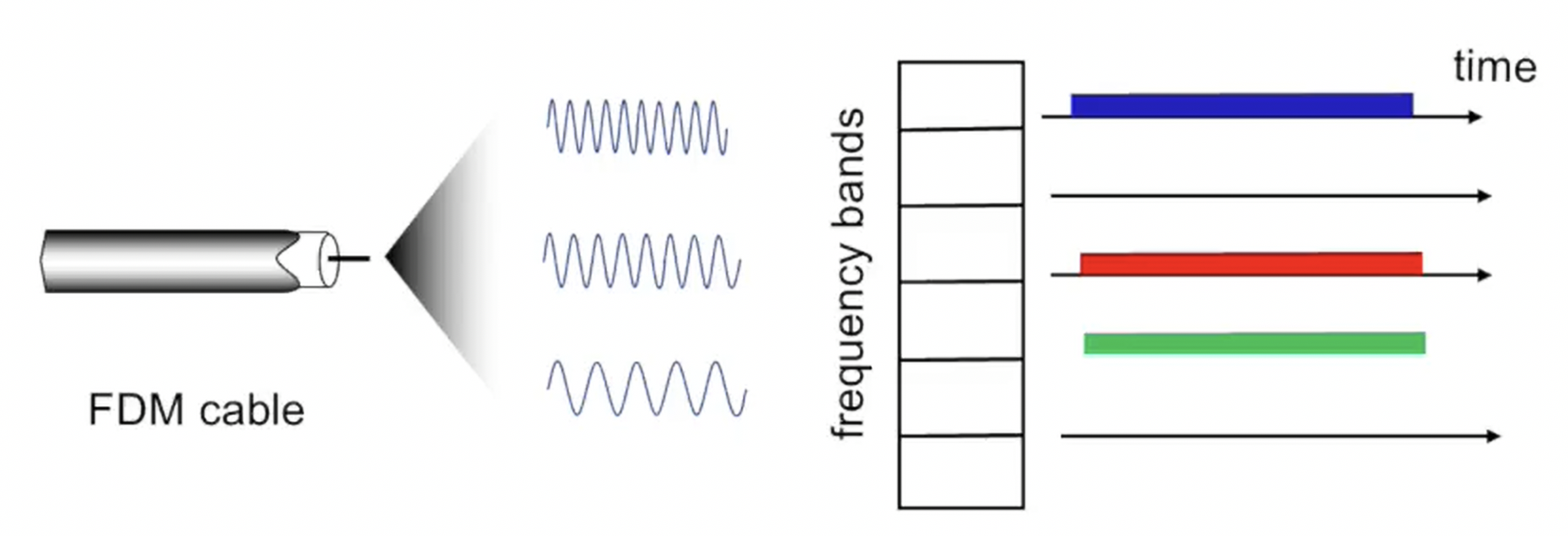
- Idea: divide frequency spectrum into bands, assign each station exclusive frequency band
- Pros: achieves fairness, simple implementation
- Cons: Bandwidth waste when nodes have nothing to transmit (static allocation)
Random Access Protocols
Nodes access channel randomly without a priori coordination:
- Transmit at full channel rate when in turn
- No coordination between nodes
- Collisions can occur and must be handled
Hence, the protocol should define:
- How to detect collisions
- How to recover from collisions
Slotted Aloha
- All frames same size
- Time divided into equal slots (one frame transmission time)
- Nodes synchronized - transmit only at slot beginning
- Collision detection through satellite rebroadcast
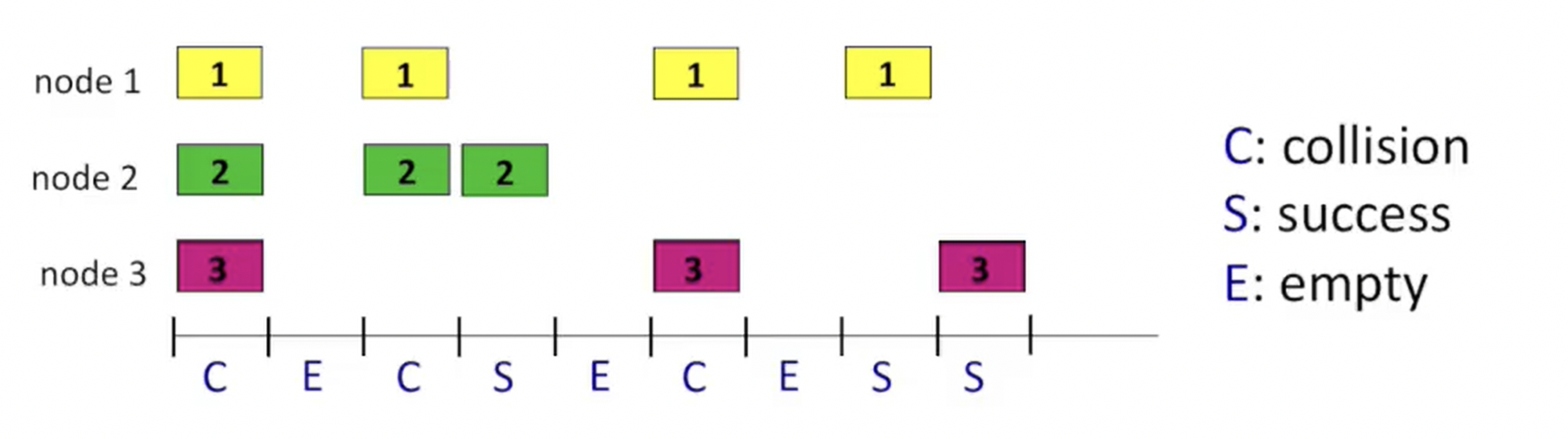
How slotted Aloha works:
- Fresh frame → transmit in next slot
- Collision → retransmit in subsequent slots with probability
- Success → move to next frame
Efficiency Analysis
Assuming we have nodes in a saturated network (always have data to send), the probability of a given node transmit successfully in a time slot is:
Therefore, the probability of any node transmitting successfully in a time slot is:
To maximize efficiency, we want to:
which is reached at , and thus the maximum efficiency is
Pure (Unslotted) Aloha
Unlike Slotted Aloha, pure aloha use simpler primitives:
- No synchronization required
- Transmit immediately when frame arrives
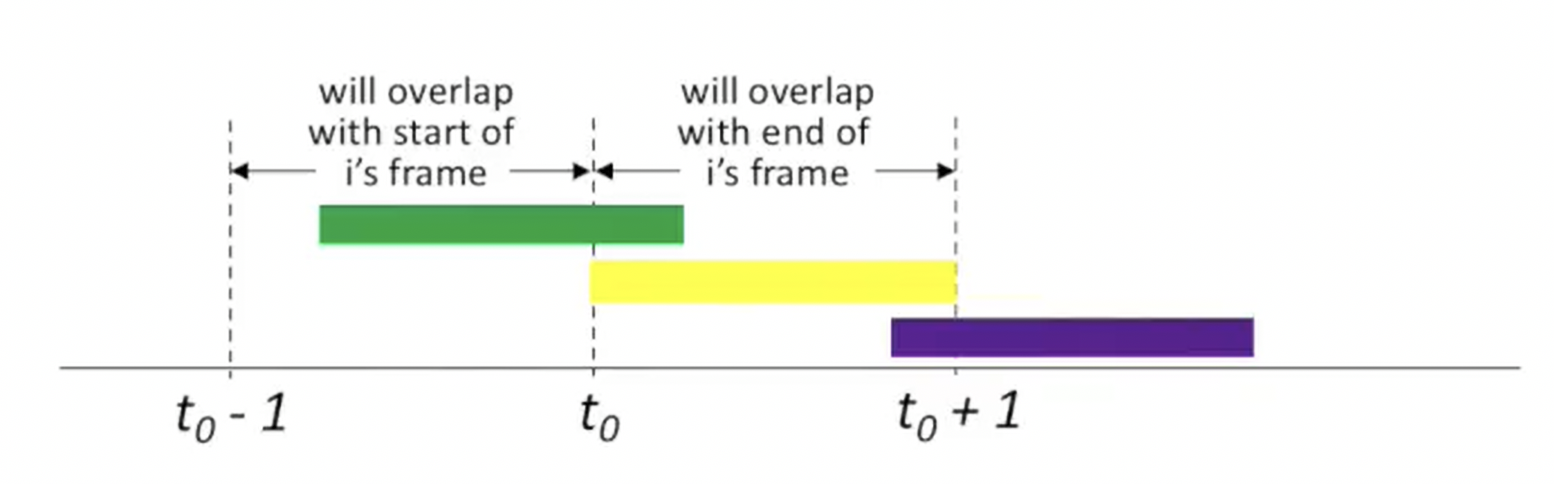
- Vulnerability period: 2 packet times (vs. 1 packet time in slotted)
Efficiency: Approximately 18% (half of Slotted Aloha)
Carrier Sense Multiple Access (CSMA)
Principle: “Listen before you speakA”
Basic CSMA Operation
- Sense channel before transmitting
- If idle → transmit entire frame
- If busy → defer transmission
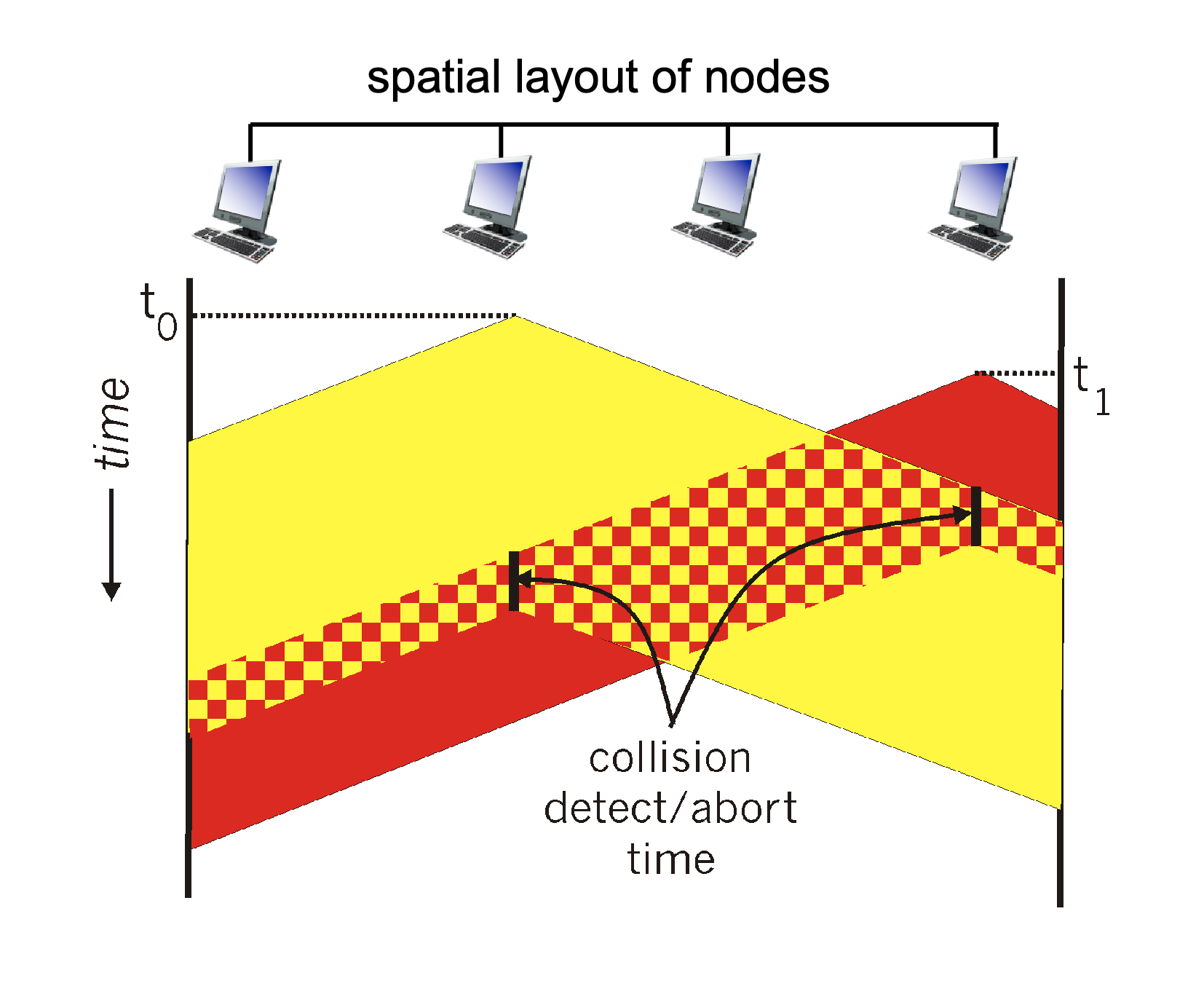
Problem: Collisions still possible due to propagation delay
CSMA/CD (Collision Detection)
CSMA/CD is widely used in ethernet, it act like a polite conversationalist, who listens while speaking, and stops talking when hearing others:
- Sense channel
- If idle → start transmission
- While transmitting → continue listening
- If collision detected → abort transmission and send jam signal
- Use Binary Exponential Backoff for retransmission
Binary Exponential Backoff (BEB)
After -th collision:
- Choose random from
- Wait bit times
- Retry transmission
Efficiency of CSMA/CD
As shown below, the CSMA/CD efficiency goes to 1 as the ratio of propagation delay to transmission time goes to 0:
where:
- : maximum propagation delay between two nodes
- : time to transmit the frame
Taking Turns Protocols
Combine benefits of channel partitioning and random access.
Polling Protocol
Operation:
- Master node invites other nodes to transmit in turns
- Master sends polling frame → node responds with data
- Used in Bluetooth
sequenceDiagram
    participant M as Master
    participant N1 as Node 1
    participant N2 as Node 2
    participant N3 as Node 3

    M->>N1: Poll
    N1->>M: Data
    M->>N2: Poll
    N2->>M: Data
    M->>N3: Poll
    N3->>M: No data
Concerns:
- Polling overhead
- Latency with many nodes
- Single point of failure (master)
Token Passing Protocol
Operation:
- Token (control message) passes sequentially between nodes
- Only token holder can transmit
- Used in ring networks
- Token released after transmission complete
Concerns:
- Token overhead
- Latency in large rings
- Single point of failure (token loss)
Key Takeaways
-
No perfect MAC protocol - each has trade-offs between efficiency, fairness, and complexity
-
Protocol choice depends on application:
- TDMA/FDMA: Predictable traffic patterns
- Random access: Bursty, unpredictable traffic
- Taking turns: Mix of both scenarios
-
Efficiency vs. Fairness trade-off is fundamental in MAC protocol design
-
Propagation delay is critical factor in collision-based protocols